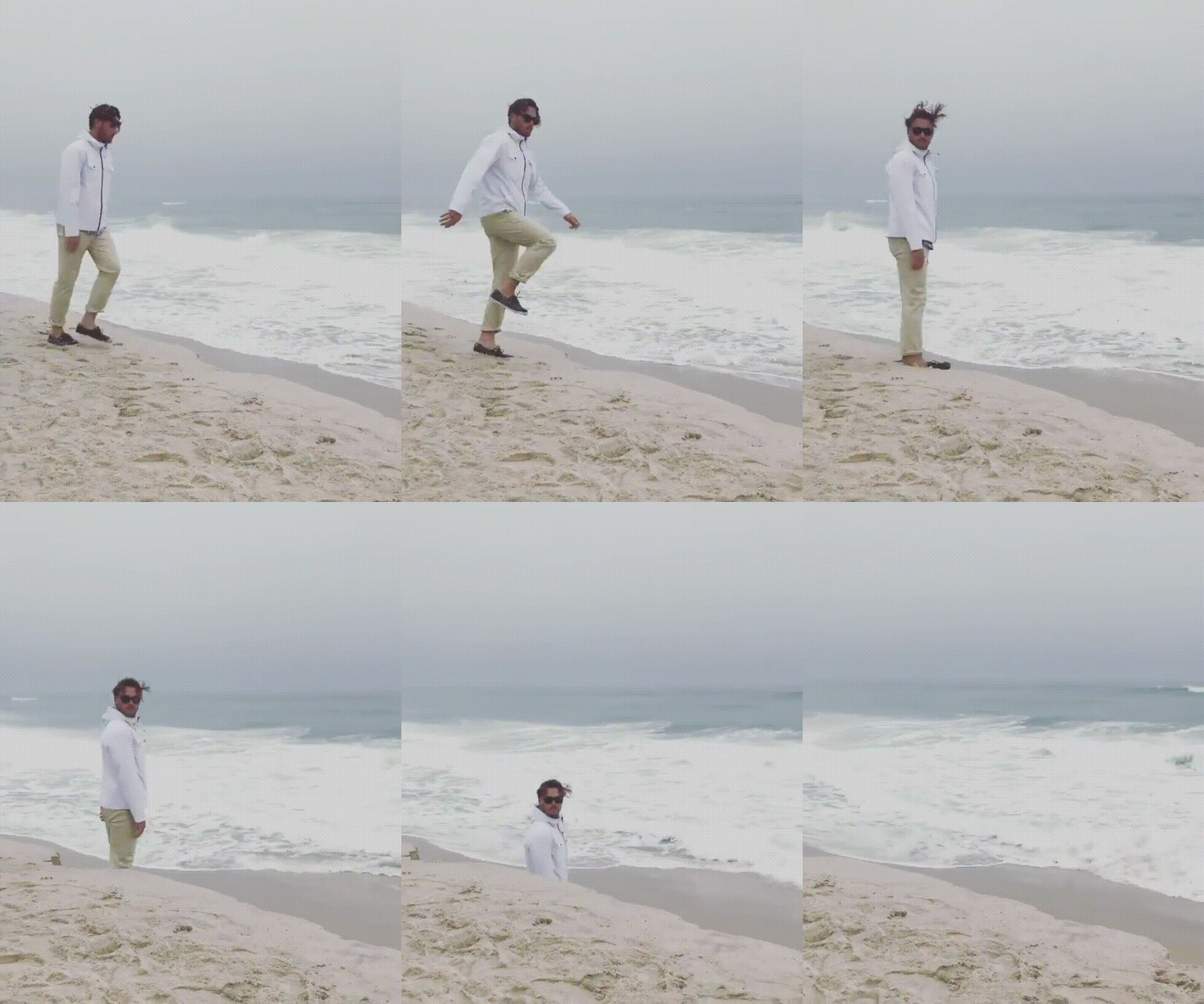
Who Am I?
Authored 2024-08-24 (modified 2024-08-27)
Est. time to read: 15 min
453492 views
Tags: [ "Blog" ]
An introduction to Tanner Morgan.
Personal Background
I'm a Mechanical Engineer with a passion for web development. I was born and raised in Missouri in the 1900s. In high school, I raced motocross all over Missouri.


These days, I no longer race motocross or own a dirt bike, but I still have a passion for two wheels (sometimes one 👀). I now have a KTM 790 Duke sport bike which has served me well for over 35,000 miles and counting!


Aside from the thrill of high-speed shenanigans, I enjoy spending time with my family. I have a beautiful, amazing wife and two beautiful daughters, who keep me on my toes. All three of my girls are Disney fanatics and would move to Florida in a heartbeat just to visit Disney World twice a month...
When I'm not spending time with my family, riding my motorcylce, and working on my blog site, I enjoy gaming and flight sims, listening to podcasts and audiobooks, deer hunting, watching football (go Chiefs!), playing golf, and amateur photography. My favorite video game of all time is Factorio, although it's often difficult to remember to eat and sleep while playing it ("The Factory Must Grow"). I'm also a student pilot working towards a private pilot's license.
Education
I went to college at Missouri University of Science and Technology (MST), graduating in 2018 with a B.S. in Mechanical Engineering. I served as Secretary of MST's ASME student organization, and then as the Contests and Awards Chairman.
During my time as the Contests and Awards Chairman at MST's ASME student organization, I had the opportunity to lead a competition focused on testing the strength of small 3D-printed parts. We designed and built a low-budget test stand that could apply significant force to these parts, allowing us to identify the strongest designs.
The test stand featured a hydraulic hand pump jack connected to a 2000lb load cell to measure the applied force. We standardized the fixture with a published bolt pattern, making it easy for contestants to attach their custom bracket designs. The load cell's data was processed by an Arduino, which displayed live readings on a small OLED screen and simultaneously sent the data to a .NET VB GUI on a connected computer. This setup allowed us to project real-time results on a large display for everyone to see during the competition.
Both the Arduino and the VB application logged the data to ensure we could track the maximum load each bracket could withstand. The competition drew significant interest, with students from various disciplines showcasing their creativity and engineering skills. To reward their efforts, we offered some substantial prizes, like a DJI drone and an Amazon gift card—huge wins for any college student.


The competition was my first exposure to a real-world engineering project that covered many aspects of what it means to be a mechanical engineer: design, manufacturing, electronics, and software. A well-rounded mechanical engineer gets to know every aspect of a project and is able to work with every member of the team.
It wasn't until my heat my heat transfer class that I really started learning that I had a new appreciation for software development and automating processes. In heat transfer, our end of year project was to solve a complex problem involving estimating heat transfer through a shaped duct. The requirement was to solve the equations, model it in MATLAB, and produce a report to be presented at the end of the year. I took it a step further and made a simple GUI application using MATLAB to allow a user to move a slider and see the heat dissipation at specific locations across a triangular duct. This simple application sort of sparked a new interest for me in the world of UI and software development.

During college, I took advantage of amazing opportunities interning at 3 different companies. Parker Hannifin was my first internship/co-op. I worked for Parker Hannifin Sporlan Valve division in Washington, MO, taking off for a semester to do so. I was a Design Engineering Co-op working in the refrigeration valve department. I designed test fixtures for a handful of stepper motors used in electronic flow control valves, and wrote the accompanying lab procedures and reports. I also had the opportunity to work on a cost savings project for a piston used inside a valve assembly. The new piston reduced the part count and simplified manufacturing processes by converting the glass-filled nylon sealing gasket into part of the structure of the piston itself. Several prototypes were built, and started undergoing lifecycle testing during my time at Parker Hannifin, although my co-op ended before I got to see the final results of the testing.
The following summer, I secured an internship at an HVAC testing and balancing engineering firm in Dallas, TX. I got to see the quoting process for testing and balancing at large facilities, work hands-on with air handling units (even got to climb inside a massive one on top of a new tech school being built, and it was very refreshing in the Dallas heat on top of a roof), and also had the opportunity to perform testing and balancing on a water cooling systme in a massive new data center being built for Facebook!
I was hired on for my final internship the following summer at ABB in Jefferson City, MO. This internship was for a process engineering role on the production line that built the external shell of large commercial and industrial 3-phase padmoount transformers. Spoiler alert, this internship would turn into my first full-time job after college. As an intern, I worked closely with a small team of engineers in the capital projects department. My main role was supporting the development of a new process for the nesting and programming of their antiquated 50-ton turret punch and laser combo machine. During the internship, I unfortunately lost a few team members to a round of layoffs that swept the organization (which was actually my second experience with layoffs as something similar occured at Parker, in which I lost my manger and our department merged into another). After the layoffs, a restructuring occured. I was already halfway through my final semester of college when the layoffs happened, so I was wary of my future at the company. However, it turned out in my favor as I was able to transition into a full-time role with ABB following graduation. I graduated December 2018, 3 weeks after getting married and going on an super relaxing honeymoon to Disney World!
Career
After starting full time at ABB, I transitioned into a shop-floor support role as a Process Engineer. I was responsible for the tank manufacturing line which produced the body of the 3-phase transformers. This section of the plant also included a shiny new fin-folding machine which produced the radiator fins that were attached to the sides of the transformers. The machine was my first experience with a multi-million dollar CapEx project, and while I didn't spearhead the project itself, I worked closely with the engineer who did, and it would prove to be extremely valuable experience.
During my time as a Process Engineer, I also worked with a team of engineers in charge of setting up a completely new design system. Much of the design of the transformers was automated. A sales team gathered all the specs that the customers were asking for, and entered the data into a massive spreadsheet. When the time came to produce designs, an automated system would translate the specs into a highly complex, but elegant set of 3D parametric models which would transform the spec sheet from simple numbers and text into actual 3D models. My piece of the pie was to help create a system that would take the 3D models (which were modeled in PTC Creo Parametric), and again transform them into flattened 2D patterns that could be used to cut steel on the punch/laser combo machine. The system interfaced with a software called SigmaNest which used a post-processor to tranlate the 2D CAD into actual code (in this case G-Code) to tell the machine where to cut material. This system was my first major experience on a cross-functional team across several departments, including the shop-floor team, the design team, the software development team, and the IS infrasturucture team. I got to help develop a Python GUI application to help engineers interact with the design system. This was also my first interaction with SQL databases (Microsoft SQLServer) as all the design and manufacturing data (aside from 3D models, drawings, and G-Code) was stored in the database.
I gradually moved into a new role working on CapEx projects again. With new investments coming in from a merger wih Hitachi Energy, new projects were coming to fruition. We got a budget to install a new punch/panel-bender combo machine, and given that we already had a Salvagnini line in the plant, it was the obvious choice for a second line. The Salvagnini lines were tasked with cutting and bending the cabinet bodies of the transformer (the front section that houses the external connections to the active unit itself). I spearheaded the nearly 2 million dollar project to purchase and install the new machine. After the machine was installed, I was also in charge of training the operators, writing work instructions, and integrating with the design system. I also wrote some helpful small desktop applications to interface between the Salvagnini database and the design system to give the operators insight into the inventory and scheduling of the machine.
My experience at ABB (and then Hitachi Energy after the merger) was extremely rewarding, but also very stressful. During my final year at Hitachi, my wife and I had our first child, and life was getting busier. I knew that a career in a process engineering role wasn't sustainable for myself. I left Hitachi in early 2022, and found my current position with EquipmentShare.
I started at EqupimentShare in February of 2022. EquipmentShare is a startup in the construction equipment industry, offering equipment rentals and sales, service, and digital technology in the form of a system called T3. I work as a Mechanical Design Engineer III in the attachments and upfitting engineering department.
Why the Blog?
In the near future, I'll be writing more about why I decided to start a blog, and go into more detail on what I want to talk about. Stay tuned and keep an eye out for more. My next post will have more detail about the site itself. Goodbye for now!